About
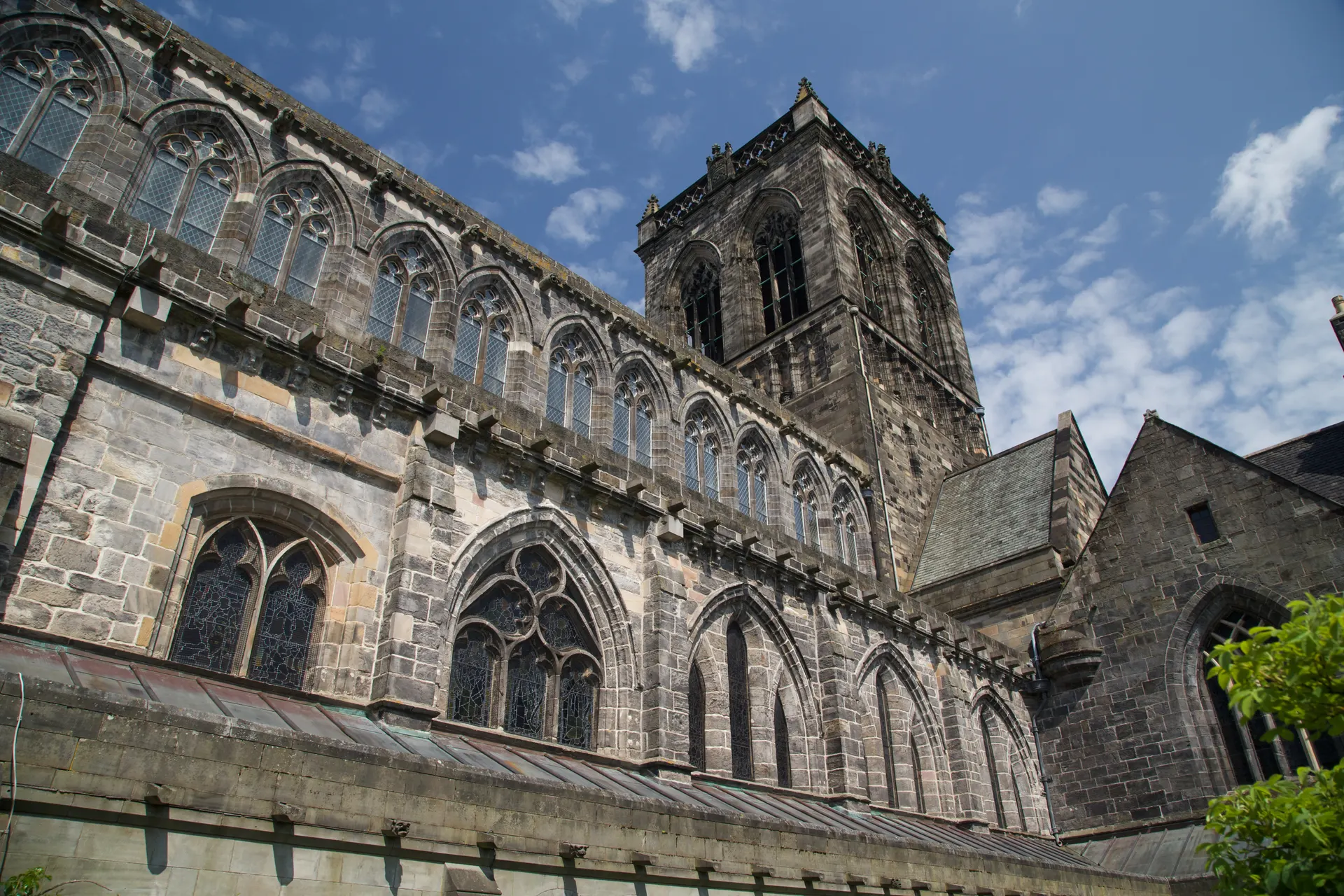
Glasgow Cathedral is Scotland's finest surviving medieval cathedral, the only one on the Scottish mainland to come through the Reformation of 1560 virtually intact, and still a working Church of Scotland parish church. It is dedicated to St Kentigern, better known as St Mungo, thought to have been buried here around 612, whose shrine drew pilgrims from across medieval Scotland. Bishop Jocelin began a major enlargement in 1181 and, after a fire, Bishop William de Bondington completed the Gothic cathedral in the mid 1200s, with pointed arches, tall traceried windows and three vaulted aisles around the presbytery and choir. Below, the great 13th-century Lower Church was built to house St Mungo's tomb, and the early-1400s pulpitum screen still divides choir from nave. Its post-war stained glass is regarded as among the finest in Britain. Entry is free with donations welcome; book a timed slot and hire the audio guide with its medieval music. Visitors find it peaceful amid the city.
Check today’s timesPick a day for times and prices
- Until 24 Dec
- Mon–Sat 10:00–16:00, last entry 15:15; Sun 13:00–16:00, last entry 15:15
- 25 Dec–7 Jan
- Mon–Thu 10:00–16:00, last entry 15:15; Sun 13:00–16:00, last entry 15:15
- 8 Jan–31 Mar
- Mon–Sat 10:00–16:00, last entry 15:15; Sun 13:00–16:00, last entry 15:15
Later dates are in the calendar.
Today, Friday 23 October
- Glasgow Cathedral10:00 – 16:00last entry 15:15
Free entry
Opening times may change at short notice.
1 April to 30 September Monday to Saturday 9.30am to 5pm, Sunday 1pm to 5pm; 1 October to 31 March Monday to Saturday 10am to 4pm, Sunday 1pm to 4pm; last entry 45 minutes before closing; closed 25 and 26 December and 1 and 2 January. Free, with donations welcome at the contactless points; Historic Scotland asks visitors to book a free entry slot in advance to guarantee entry. Closures for services and events in autumn 2026: the north side of the quire and the Lower Church closed 14 to 19 October, the quire closed until 2pm on 19 October and all day on 30 October, early closing at 2.30pm on 7 November; daily prayers at 1pm and Sunday worship at 11am. A reviewer saw the spire under restoration in July 2026.
Approached over paving, lowered kerbs and cobbles; the main south entrance has four stone steps up into the nave, and the west door has a stair lift (not for mobility scooters or heavier chairs) with a call point for the stewards; stairs down to the Lower Church. No toilets at the cathedral: the nearest adapted toilet is at the St Mungo Museum 15 m away, or John Lewis in Buchanan Galleries when the museum is closed. Shop; audio guide for a charge (20 per cent off for HES members); no cafe. Only assistance dogs are admitted.
Photo: Glasgow Cathedral's central spire and green-roofed Gothic nave and choir seen from the Necropolis, with the Royal Infirmary behind and autumn trees around. Marek Śliwecki, CC BY-SA 4.0. Source: https://commons.wikimedia.org/wiki/File:Glasgow_Glasgow_Cathedral.jpg. Licence: https://creativecommons.org/licenses/by-sa/4.0. Resized and cropped for display; derivatives retain the source licence.
Reviews & Tips
No reviews yet
No reviews yet. Be the first to share your experience!